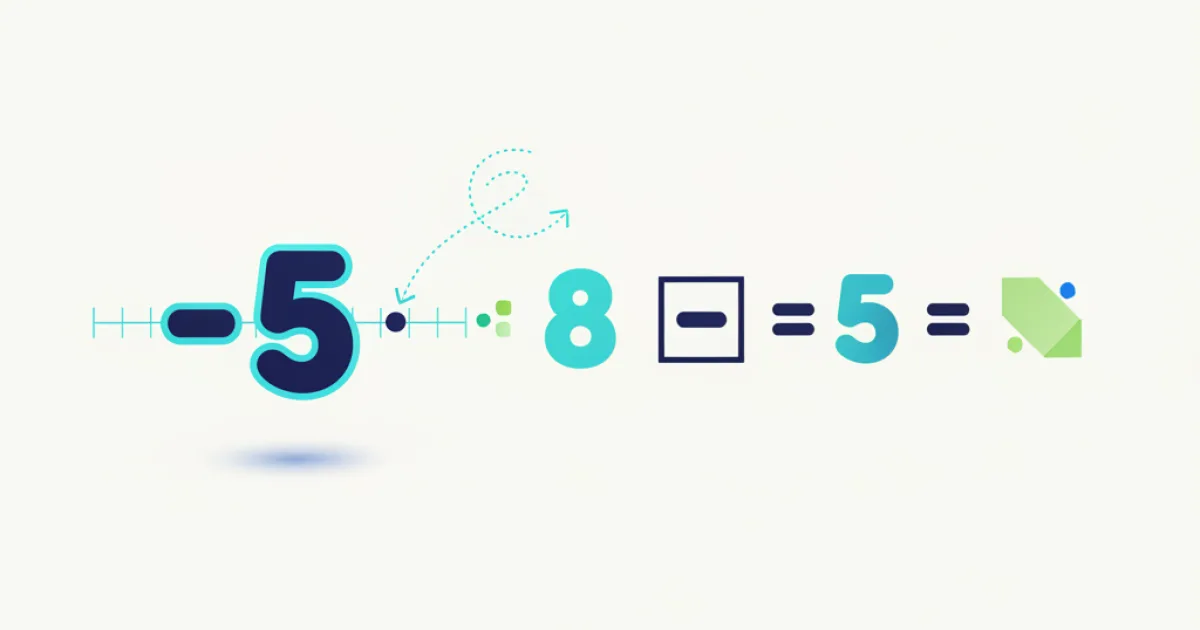
To write a negative number in words, place “negative” before the number, such as “negative five” for -5. In everyday speech, “minus five” is also common, especially when reading a calculation or temperature. In formal math writing, “negative” describes the value of the number, while “minus” often refers to the subtraction operation.
Negative vs. Minus: What Is the Difference?
The words “negative” and “minus” are often used interchangeably in everyday conversation, but in mathematics, they usually have distinct meanings. Understanding this difference is key to writing and speaking about numbers clearly.
- Negative: This word describes the property of a number. A negative number is any number less than zero. When we say "negative five" for -5, we are describing the value of that number. It tells us where the number is located on the number line.
- Minus: This word primarily refers to the operation of subtraction. When you see "8 - 5," you read it as "eight minus five," meaning you are taking away 5 from 8. The symbol ( - ) in this context is an operator.
The symbol itself, a short horizontal line, can be confusing because it serves both purposes. When it appears before a single number (like -5), it indicates that the number is negative. When it appears between two numbers (like 8 - 5), it usually indicates subtraction.
How to Write Negative Whole Numbers in Words
Writing negative whole numbers in words is straightforward. You simply place the word “negative” before the word form of the positive number.
- -5: negative five
- -12: negative twelve
- -100: negative one hundred
- -5,000: negative five thousand
While “negative five” is the mathematically precise way to describe the number -5, it is common in spoken language, especially for temperatures or informal counts, to hear “minus five.” For instance, "The temperature is minus five degrees Celsius." However, in formal written contexts, “negative” is generally preferred for describing the number's value.
How to Write Negative Decimals in Words
When dealing with negative decimals, you follow a similar pattern, placing “negative” at the beginning. How you read the decimal part can vary between everyday speech and more formal or precise contexts.
Everyday Decimal Reading (using "point"):
- -3.5: negative three point five
- -0.25: negative zero point two five
- -14.07: negative fourteen point zero seven
Formal Fractional Reading (if useful for precision):
For greater mathematical precision, especially when the fractional value is important, you can express the decimal part as a fraction. This is less common in everyday speech for negative numbers but can be helpful in specific educational settings.
- -3.5: negative three and five tenths
- -0.25: negative twenty-five hundredths (the "zero" is often omitted when there's no whole number part, but "negative zero and twenty-five hundredths" is also correct)
How to Write Negative Money Amounts in Words
Writing negative money amounts requires careful consideration of the context. While you can directly state the negative value, it’s often clearer to describe the financial situation it represents.
Direct Reading:
- -$25.75: negative twenty-five dollars and seventy-five cents
- -$100.00: negative one hundred dollars
Contextual Descriptions:
In financial settings, instead of simply saying “negative twenty-five dollars,” it is often more practical and informative to describe what the negative amount signifies. This helps avoid confusion and provides immediate context.
- This might be referred to as a "loss of twenty-five dollars and seventy-five cents."
- It could indicate a "debt of twenty-five dollars and seventy-five cents."
- It might represent a "refund of twenty-five dollars and seventy-five cents."
- It could be described as a "negative balance of twenty-five dollars and seventy-five cents."
Always consider your audience and the purpose of the communication when expressing negative money amounts.
When to Use “Negative” and When to Use “Minus”
Choosing between “negative” and “minus” depends heavily on the situation:
- Use "Negative" when:
- You are describing the inherent value of a number (e.g., -5 on a number line).
- In formal mathematical writing, textbooks, and scientific reports.
- When specifying a number that is below zero as a quantity.
- Examples: "The solution has a charge of negative two." "The range of values includes negative numbers."
- Use "Minus" when:
- You are indicating the operation of subtraction (e.g., 8 - 5).
- In casual conversation, especially for temperatures (e.g., "It's minus ten degrees").
- When reading out calculations (e.g., "Eight minus five equals three").
- In informal speech, it's often used interchangeably with "negative" for standalone numbers, though "negative" is technically more precise for the number's value.
Comparison Table
| Number or expression | Best written form | Common spoken form | Explanation |
|---|---|---|---|
| -5 | negative five | negative five or minus five | Describes the value of the number below zero. |
| -12 | negative twelve | negative twelve or minus twelve | Describes the value; "negative" is preferred in writing. |
| -100 | negative one hundred | negative one hundred or minus one hundred | Clearly states the value is below zero. |
| -3.5 | negative three point five (everyday) negative three and five tenths (formal) | negative three point five | "Negative" indicates value; decimal part read clearly. |
| -0.25 | negative zero point two five (everyday) negative twenty-five hundredths (formal) | negative zero point two five | "Negative" indicates value; "zero" or omission depends on context. |
| -$25.75 | negative twenty-five dollars and seventy-five cents | negative twenty-five dollars and seventy-five cents | Describes the amount. Often contextualized as a loss, debt, or negative balance in finance. |
| 8 - 5 | eight minus five | eight minus five | "Minus" here indicates the operation of subtraction. |
Common Mistakes
Here are a few common pitfalls to avoid when writing or speaking about negative numbers:
- Using "minus" for a standalone negative number in formal writing: While understood in speech, "negative" is more precise for the value itself in written mathematical or scientific contexts.
- Confusing the operation with the value: Remember that the symbol can mean "subtract" or "negative value." Be clear which one you intend.
- Omitting "negative" for decimals or money: Always include "negative" when the number is indeed below zero, even if the context seems to imply it.
Practice Exercises
- Write -9 in words.
- Write -42 in words.
- Write -6.75 in words.
- Explain the difference between -5 and 8 - 5.
- Write -$100.50 in words with a context note.
Answers to Practice Exercises
- negative nine
Explanation: For a whole number, simply add "negative" before its word form.
- negative forty-two
Explanation: The same rule applies to larger whole numbers.
- negative six point seven five (everyday reading)
Explanation: For decimals, "negative" precedes the whole number, followed by "point" and the individual digits.
- The difference lies in whether the symbol indicates a value or an operation.
-5 represents the number "negative five," a value less than zero. The minus sign here denotes the number's negative property. 8 - 5 represents the subtraction operation "eight minus five," meaning 5 is being taken away from 8. The minus sign here is an operator.
- negative one hundred dollars and fifty cents
Context note: This might represent a debt, a loss, or a negative balance of one hundred dollars and fifty cents.
FAQs
- Is it “negative five” or “minus five”?
Both "negative five" and "minus five" are commonly used for -5. "Negative five" is generally preferred in formal written math to describe the number's value. "Minus five" is frequently heard in everyday speech, especially for temperatures or informal calculations.
- Is “minus” the same as “negative”?
No, not strictly. While the same symbol is used, "minus" typically refers to the operation of subtraction (e.g., 10 - 3), whereas "negative" describes a number's property or value (e.g., -3 is a negative number). In casual speech, they are sometimes used interchangeably for numbers below zero.
- How do you write a negative decimal in words?
You usually write "negative" followed by the whole number part, then "point," and then each digit of the decimal part. For example, -3.75 is "negative three point seven five." In formal contexts, you might also use a fractional reading, such as "negative three and seventy-five hundredths."
- How do you write a negative money amount in words?
You can write it as "negative [amount]," such as "negative twenty dollars." However, in financial contexts, it's often clearer to describe the situation, such as "a debt of twenty dollars," "a twenty-dollar loss," or "a negative balance of twenty dollars," to provide immediate meaning.
- Is -0.25 read as “negative zero point two five” or “negative twenty-five hundredths”?
Both are correct, depending on the context. "Negative zero point two five" is the common everyday reading. "Negative twenty-five hundredths" is a more formal or precise fractional reading, which can be useful in specific mathematical or educational settings.
Short Practical Summary
To accurately write negative numbers in words, always begin with “negative” to describe the number's value below zero. While “minus” is common in informal speech and for subtraction operations, “negative” maintains clarity and precision in formal writing, especially for whole numbers, decimals, and financial amounts. Understanding this distinction helps ensure clear communication in all contexts.